Restless Cities is a collection of essays that explore the image of cities portrayed in various media, from books to movies. Each essay is concerned with a particular theme, like "Bombing" or "Convalescing". I have to admit, I did not take much away from this book. The essays were interesting enough, but seemed more concerned with the critiquing of the media than with exploring the city. Certainly some of the essays were more enlightening than others, but I found myself near the end of the book struggling to stay interested.
Restless Cities cover
Some of the essays I found more interesting included: "Bombing", "Commuting", and "Driving". "Bombing" explored the current trend toward 24-hour electronic consumerism. "Commuting" was concerned primarily with the commuter as an inhabitant of the city. Commuting becomes a strange middle ground between work and leisure; while one is not working while commuting, it is still a major time cost and certainly not leisure time. It is similar in many senses to child care, cooking, etc.--all actions which are necessary for working, but do not bring a direct paycheck. Finally "Driving" is about driving of course. It is interesting because it explores people's shifting perceptions of the city as they travel at different speeds: 0-30 mph, 30-55 mph, 55-100 mph, and 100+ mph.
There certainly is some valuable information in this book, but I found it somewhat tedious to read. The references to media either required long summaries of the context or no added context, making them laborious or not very informative without reading the original text. I would not really recommend this book unless you have more of an interest in the image of the city as it has been presented throughout the 19th-21st in media. Plus, it was much more sociological than architectural/city planning.
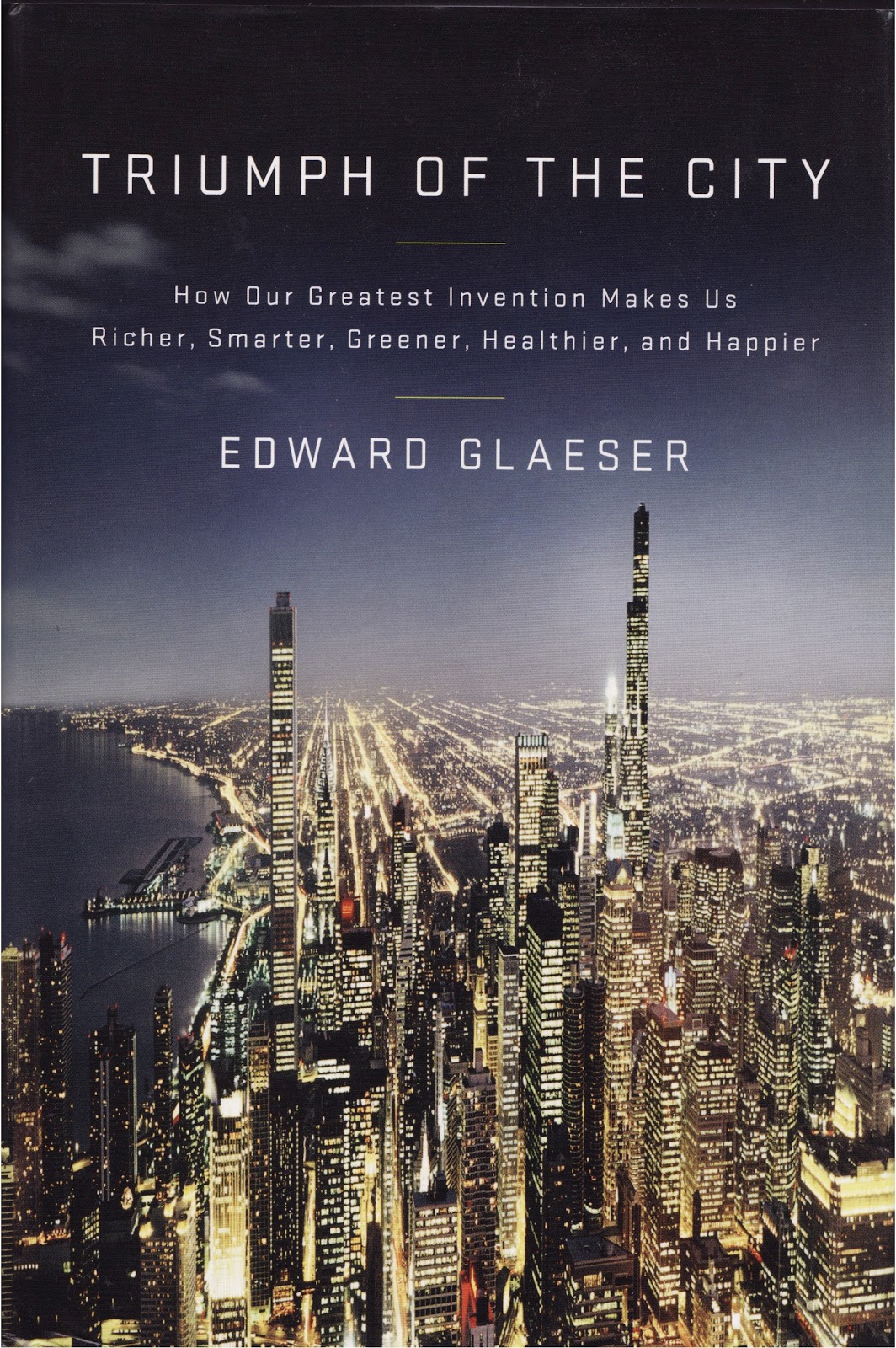
Cities recently have fallen out of vogue for most of America. When I think of public opinion about cities it seems they fall into one of three categories: Suburbia (like my hometown of San Jose), Dying (like Detroit), or Playgrounds for the Rich (like New York or San Francisco). These three views hardly do justice to the power that cities have to improve the lives of everyone. Bringing to light the benefits to humanity that cities bring is one of the subjects of Edward Glaeser's book: The Triumph of the City.
Triumph of the City by Edward Glaeser
The subtitle of this book outlines the contents of this book well: How our Greatest Invention Makes us Richer, Smarter, Greener, Healthier, and Happier. This may be quite counter to the view points of critics who see cities as dark, dirty, havens of crime; but Glaeser backs up his claims effectively and with DATA! This is because he is an economist, so he doesn't fall into the traps that many architects and planner do when extolling the benefits of city life--which they generally approach from a more vague ideological standpoint.
But how can he make these claims? Cities make us richer because they are powerhouses of economic activity. The concentrations of people foster new inventions, competition, and specialization that cannot occur in rural communities. They make us smarter by connecting people with like minded interests. People learn best from face to face conversation and experience, and cities are hotbeds for this. Like the coffee shops of Paris that fostered the arguments that fueled France's philosophical breakthroughs. They make us greener because people who live in cities consume less energy. The smaller living spaces require less energy to heat, cool and light. The proximity of amenities and increased efficiency of public transportation in dense urban areas means residents do not have to drive as much. They make us healthier because it promotes a healthier lifestyle. People walk more in cities and they have access to the best hospitals and medical professionals. The make us happier because they offer amenities that cannot be supported by less dense populations. Museums, fancy restaurants, and theaters all need a strong clientele to survive and the density of cities provides just that.
It really did not take much to convince me that cities were the way to go, when I read this book. After all I already believed that cities were the best bet for the advancement of humanity. But if you believe suburbia or rural life is best (and there are advantages to both) then read this book and it is sure to change your perspective. Of course, Glaeser does not argue that the other forms of living should be eliminated, but we do need to promote cities, which seems to be at the back of most people's minds.
If you are like me and believe that cities are already everything he describes in his subtitle, I still recommend this book. He gives the data that can back up the claims of city life superiority and you might find some benefits of the city that you did not know before. For example, as bad as conditions are in slums and favelas, he points out that life in these places is much better than their rural counterparts. They have better wages, better living conditions, and much more social and economic mobility. Plus, he also includes suggestions on how to improve our cities, how to fight suburban sprawl, and ways to promote city life. This book is a great read and is full of useful information, and I recommend it for anyone that is interested in cities, thinks cities are bad, and professionals in the design and planning professions alike.
While 28 Days Later does not have much of a commentary on what the future of architecture may be, it does contain an awesome scene of an empty London. Something we may never see, the empty streets of London are a moving visual. Is it swine flu? Bird flu? No, it is rage! I imagine any number of rage-infected zombies would be able to scare off an entire city. That is what happens when you infect chimps with rage and Greenpeace gets involved. The movie is filled with images of a deserted city including aerial pans and the like. One gets a totally different perspective on the city watching two lonely survivors navigate its streets. Plus, I love the camera angles in this movie. At times it feels like you are watching the movie from the angle of a security camera. Something about the still camera not moving with the actors, makes for some really cool visuals.
Exploring an empty London
For a little contrast, here is a joiner I took of the same bridge he is on near the beginning of the clip from my most recent trip to London. As you can see, there is a lot more people in my joiner than in the clip.
Parliament and Big Ben from Westminster Bridge
If you are into zombie horror movies this is your movie. Still the images of the city they use are breathtaking and I would recommend them to anyone. Here is a few more of my favorites:
Architecture is a huge part of all forms of media. Just look at car commercials. They show the car either driving down Highway 1 in California or in front of famous buildings. Just the other day I saw one where the car was parked in the plaza of Morphosis's Caltrans building in Los Angeles. In movies, architecture often plays an even more integral role. Science fiction movies often show us a vision of our future, whether it be robots or spaceships, they always include a commentary on the environment we will inhabit in the future. One of my favorite such movies is Bladerunner.
It stars such sci-fi greats as Harrison Ford (possibly my favorite actor) and Edward James Olmos, so you know it will be good. But, more striking than the great actors, is the vivid world in which it is set. To help set the scene, here is the text from the opening:
Early in the 21st Century, The Tyrell
Coporation advanced Robot evolution
into the Nexus phase--a being virtually
identical to a human--known as a Replicant.
The Nexus 6 Replicants were superior
in strength and agility, and at least equal
in intelligence, to the genetic engineers
who created them.
Replicants were used Off-world as
slave labor, in the hazardous exploration and
colonization of other planets.
After a bloody mutiny by a Nexus 6
combat team in an Off-world colony,
Replicants were declared illegal
on earth--under penalty of death.
Special Police Squads--Blade Runner
Units--had orders to shoot to kill, upon
detection, any trespassing Replicant.
This was not called execution.
It was called retirement.
I love those last two lines, there is something very erie about them. Anyways, the movie is set in Los Angeles in November of 2019. Los Angeles does not look like it does today. It is dark, polluted and wet. The city has been built up to an incredible density and the skyline is dominated by the two pyramid like buildings of the Tyrell Corporation. Its a fascinating portrayal of what our world might turn to as the human population continues to sky rocket. Certainly, if we continue developing land through sprawl as we have been, there will soon be no open land left. Once we can no longer spread horizontally, we must go vertically. What does this vertical expansion mean for a city?
These are stunning visuals of the city of the future (and I love that it is not CGI). The movie presents a city that is dark and gloomy. There is a social stratification just in the hierarchy of where people live, yet the rich no longer live in gated communities, but in the sky. They are probably the only people that get to see the sun. The entire movie is dark and one can only ponder why, after all it cannot be all set at night. Instead it seems to be a mixture of the pollution, buildings, and rain that make it so dark. With buildings as tall and as dense as is in the movie, no sunlight can reach the street. Instead the poor live in a world flooded by neon and fluorescent light--hardly an environment I would like to live in. Even Deckard who lives on the 97th floor of his building barely gets any light into his apartment. This type of scene could certainly be the New York of today if they had never enacted their zoning envelope law that prevent buildings from being so bulky that they block light and air from the street. Los Angeles in this films makes the watcher ponder what the future of of cities will be like, and especially for me, how to expand our cities and make them more dense without making them unlivable?
I love the style of the buildings in this movie as well. The buildings look both ancient and futuristic. The style of the ornament is very geometric and resembles old styles of Greece, Asia, Egypt and Central America. It is all those styles combined, yet completely new. It gives the buildings a sense of permanence and age. On their exteriors, the buildings are laden with neon advertisements for small shops on the street and major corporations in the air. In the dark it is difficult to make out much of the buildings except for lit windows, warning lights, and what is illuminated by search lights from passing blimps with advertisements to move Off-world, where there is ample space for recreation. Earth seems spent. Her open space has turned to endless city (at the end of the movie Deckard is driving through woods, but it is not clear whether he is still on Earth or on a colony), her animals have become extremely rare and instead are manufactured by genetic engineers in the street, and her buildings look old, run down and patched together with new technology. Giving to the appearance of the decrepit buildings is the movie's use of current architecture. Much of the movie, including the climax, is set in the now nearly abandoned Bradbury Building and the interior of the police station is LA's Union Station, I believe. It is not the best scenario for our future and one that can be avoided with some simple planning and preservation.
This movie is definitely one of my favorites. The setting and music give us any erie sense of what our future might look like. My only suggestion is watch the director's cut, then you don't have to listen to Deckard's inner thoughts as he narrates--which was not supposed to be a part of the movie originally. I watched the director's cut the first time I saw the movie and there were some things I did not understand, but that was all right. Anything you need to know and understand to make sense of the movie is explained in the movie with out the narration. Besides, its a movie about the future and we cannot be expected to understand everything that happens in the future, like the street language that sounds like gibberish. The future is unknown and this movie really does feel like the future when some much is unfamiliar, strange and incomprehensible. Besides then you don't have to hear Harrison Ford say this wonderful little nugget:
"Sushi, that's what my ex-wife calls me. Cold fish."